
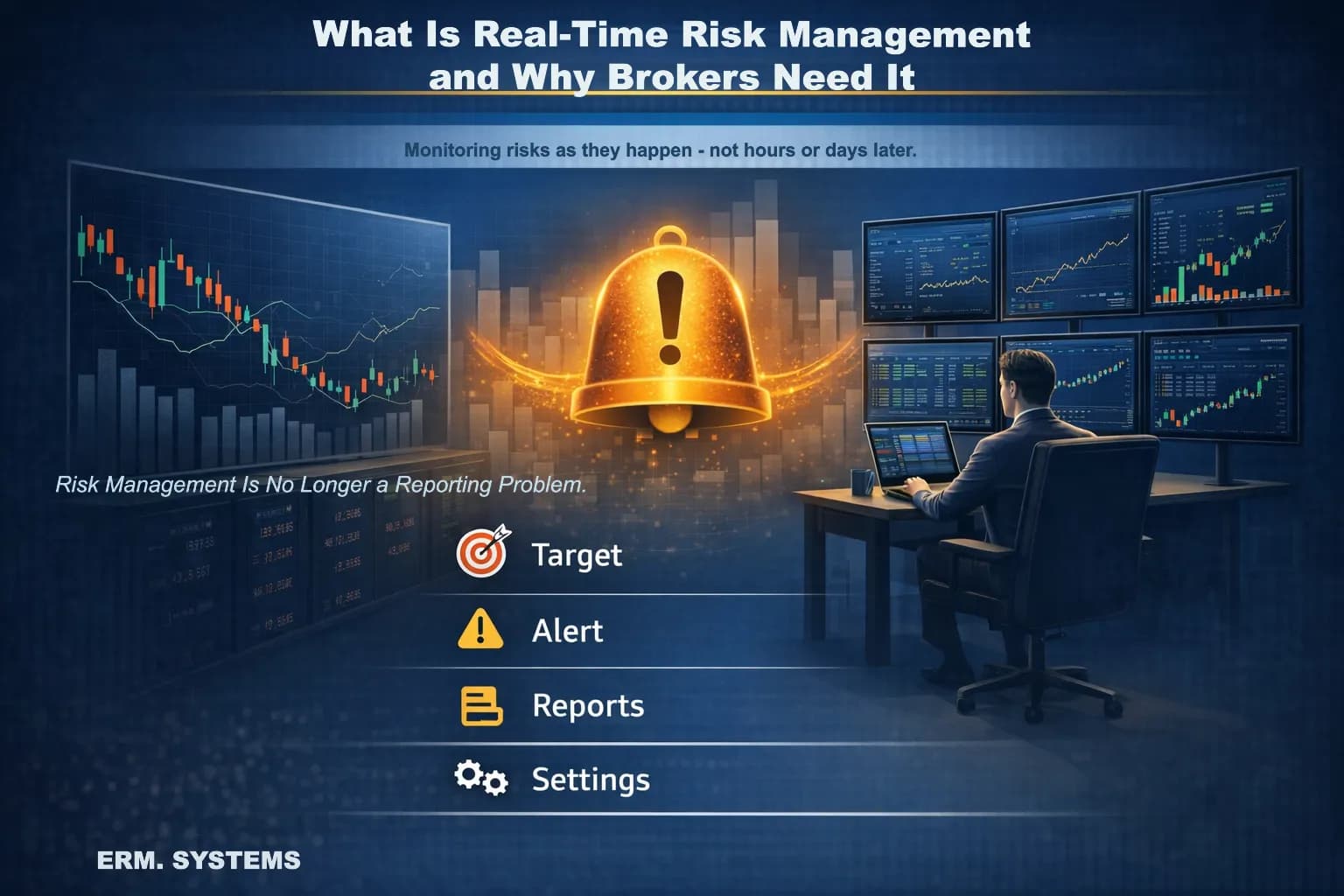
What Is Real-Time Risk Management and Why Brokers Need It
A practical look at why brokers need real-time risk management, what such systems should actually solve, and how ERM Systems approaches the problem.
Risk Management Is No Longer a Reporting Problem
For many brokers, risk monitoring still depends on delayed reports, fragmented dashboards, and manual reconciliation between teams.
That approach may have been acceptable when volumes were lower and teams had more time to react. It becomes much harder to defend when exposure changes intraday, client activity becomes more aggressive, and management expects faster decisions.
The core issue is not lack of data. It is the gap between risk appearing and the business being able to respond.
When that gap is too wide, brokers start operating with delayed visibility. By the time someone notices a concentration build-up, a margin problem, or an abnormal trading pattern, the situation is already moving.
What Real-Time Risk Management Actually Means
Real-time risk management is the ability to monitor, measure, and act on trading risks as they happen — not hours or days later.
In practice, that means more than a fast dashboard. It means the broker can see meaningful risk signals while they are still actionable.
A real-time risk system should help teams answer questions like:
- Where is exposure building right now?
- Which accounts need attention first?
- Is the issue isolated, or system-wide?
- Does dealing need to intervene, or is this normal activity?
That is what makes real-time monitoring operationally useful.
Why Brokers Need It
For a broker, risk is not managed at the end of the day. It is managed during the trading day, while positions, prices, and client behavior are changing.
A well-designed real-time risk setup helps with several things at once.
1. Faster Response to Exposure Changes
When exposure is visible as it develops, teams can react earlier instead of explaining the situation after it has already escalated.
2. Better Prioritization
Not every signal deserves the same level of urgency. Real-time visibility helps risk and dealing focus on the accounts, symbols, and situations that actually matter.
3. Stronger Cross-Team Coordination
Risk, dealing, compliance, and management need a shared picture of what is happening. A fragmented monitoring stack slows that down.
4. Less Manual Monitoring
The more a team depends on spreadsheets and manual checks, the harder it becomes to scale oversight without adding operational noise.
Where Many Platforms Fall Short
Many platforms are good at showing data. Fewer are designed to support real brokerage workflows around that data.
A broker does not only need charts and status cards. The broker needs operational visibility:
- live exposure across accounts and symbols
- alerting that can be configured and trusted
- the ability to drill down from firm-level risk to account-level context
- a shared view for risk, dealing, and management
Without that, a platform may look modern while still leaving teams to do the real work manually.
How ERM Systems Approaches the Problem
ERM Systems is built around that operational layer.
The goal is not simply to display data faster. It is to help brokers move from delayed observation to live control.
In practical terms, that means combining several capabilities in one workflow:
- real-time exposure and P&L visibility
- configurable risk alerts
- drill-down from portfolio view to account and position detail
- client behavior and profile context
- shared visibility for risk, dealing, compliance, and management
This matters because risk rarely appears in a single form. Sometimes it is concentration. Sometimes it is margin pressure. Sometimes it is a client pattern that is not yet critical, but clearly deserves attention.
ERM Systems is designed to make those signals easier to see, interpret, and act on without forcing teams to stitch the story together across multiple tools.
Why That Difference Matters
The difference between a useful risk platform and a superficial one is rarely the speed of the UI alone. It is whether the platform helps a broker answer a simple operational question:
Where do we need attention right now, and why?
That is where real-time systems become valuable. Not because they make dashboards look more live, but because they shorten the distance between market events, risk visibility, and business response.
That is also where ERM Systems fits best: as a platform for brokers who need a clearer, faster, and more operational view of risk as it develops.
Final Thought
If risk monitoring still depends on delayed reports and manual interpretation, the problem is not only efficiency. It is decision quality.
Real-time risk management matters because brokers need to see the situation early enough to do something useful about it.
If you are reviewing how your risk operations are structured today, contact us to see how ERM Systems approaches real-time visibility, alerting, and brokerage risk control.